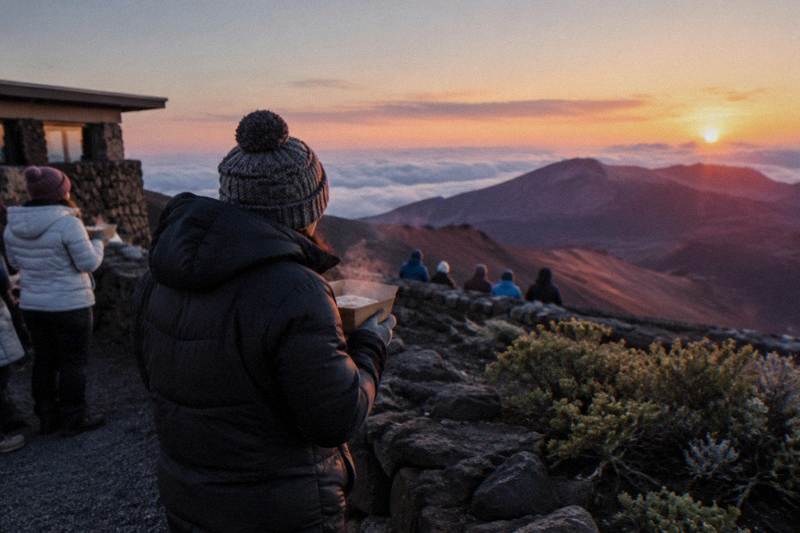
Haleakala Sunrise Time By Month And When To Leave
Sunrise over the Haleakala crater moves by more than 80 minutes between summer and winter, and that single fact sets the wake-up call for every visitor on Maui, whether they drive themselves or ride a coach to the top.
Short answer
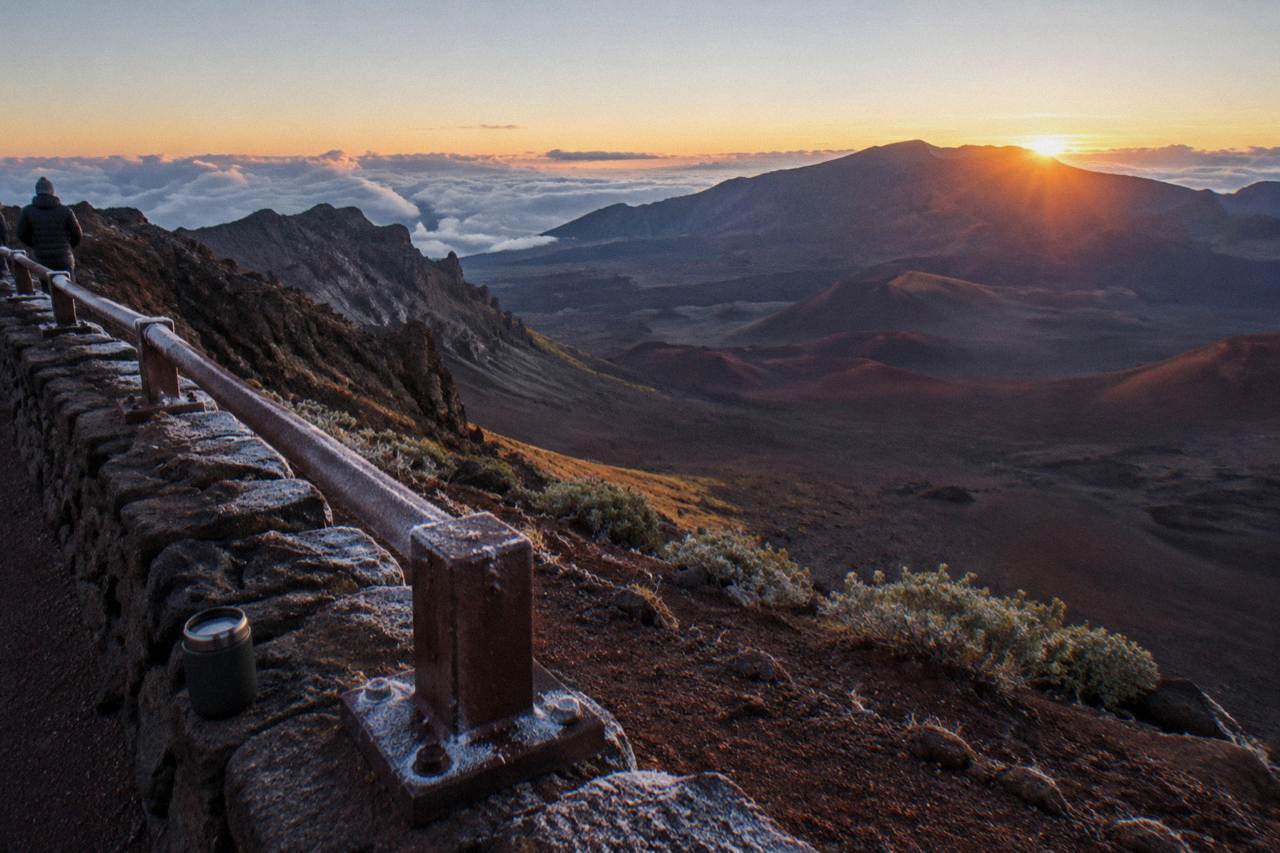
Sunrise at Haleakala ranges from about 5:44 a.m. in late June to about 7:04 a.m. in mid-January. To claim a spot at the 10,023 ft summit you need to arrive well before first light, which means leaving Lahaina as early as 3:00 a.m. in summer and closer to 4:45 a.m. in deep winter.
The sun rises over the Haleakala crater at 5:44 a.m. in mid-June and not until 7:04 a.m. in mid-January. That 80-minute swing is the single number that decides what time a sunrise visit starts, because the park's own guidance is blunt: parking lots close when full, and the four sunrise viewing areas hold only about 150 vehicles. Show up late and the trip becomes a drive to a full lot.
The times below are computed for the summit horizon, so they are what a person standing at Pu'u 'Ula'ula (Red Hill), 10,023 ft up, would actually see. Sea-level Maui beach sunrise runs a few minutes different. This guide gives the month-by-month table, works through the departure math from Kahului, Kihei and Lahaina, and shows how sunrise time quietly sets the pickup clock of every commercial sunrise tour on the island, from the nine-hour coach sunrise with breakfast to the self-guided sunrise bike ride.
What Time Does The Sun Rise At Haleakala Each Month?
Sunrise at the Haleakala summit ranges from about 5:44 a.m. in mid-June to about 7:04 a.m. in mid-January, a swing of well over an hour across the year. Sunset moves almost as much, from about 5:45 p.m. in November to about 7:09 p.m. in July. The dates below are computed for the 15th of each month, Hawaii Standard Time.
Hawaii does not observe daylight saving time, which is why the summer gap between mainland sunrise and island sunrise keeps growing through the season. A visitor flying in from the West Coast in June feels the early hour twice over: their body clock reads three hours ahead, and the sun comes up before 6 a.m. local. The actual day of a visit shifts a minute or two either side of the 15th, so treat the table as the center of a small range rather than a train schedule.
| Month (15th) | Sunrise (HST) | Sunset (HST) | Notes for the summit |
|---|---|---|---|
| January | 7:04 a.m. | 6:04 p.m. | Coldest mornings, often below freezing |
| February | 6:56 a.m. | 6:23 p.m. | Late sunrise still, rainy season |
| March | 6:35 a.m. | 6:35 p.m. | Fast change, roughly a minute earlier daily |
| April | 6:07 a.m. | 6:43 p.m. | Spring transition |
| May | 5:48 a.m. | 6:54 p.m. | Early starts return |
| June | 5:44 a.m. | 7:06 p.m. | Earliest sunrise of the year |
| July | 5:52 a.m. | 7:09 p.m. | Latest sunset of the year |
| August | 6:04 a.m. | 6:56 p.m. | Sunrise creeping later again |
| September | 6:12 a.m. | 6:29 p.m. | Rapid shift toward winter times |
| October | 6:20 a.m. | 6:02 p.m. | Comfortable mid-range wake-up |
| November | 6:35 a.m. | 5:45 p.m. | Earliest sunset of the year |
| December | 6:53 a.m. | 5:47 p.m. | Long, dark mornings; near-latest sunrise |
Two practical reads from that table. First, winter is the friend of late sleepers: a 7:04 a.m. sunrise in January means leaving Kihei around 4:45 a.m. rather than the 3:15 a.m. of June. Second, the change is not even. Around the solstices the times barely move for weeks, while late February into March the sunrise jumps earlier by close to a minute a day. Visitors comparing two trips a few weeks apart in spring sometimes assume the published time is wrong. It is not; the calendar simply moved.
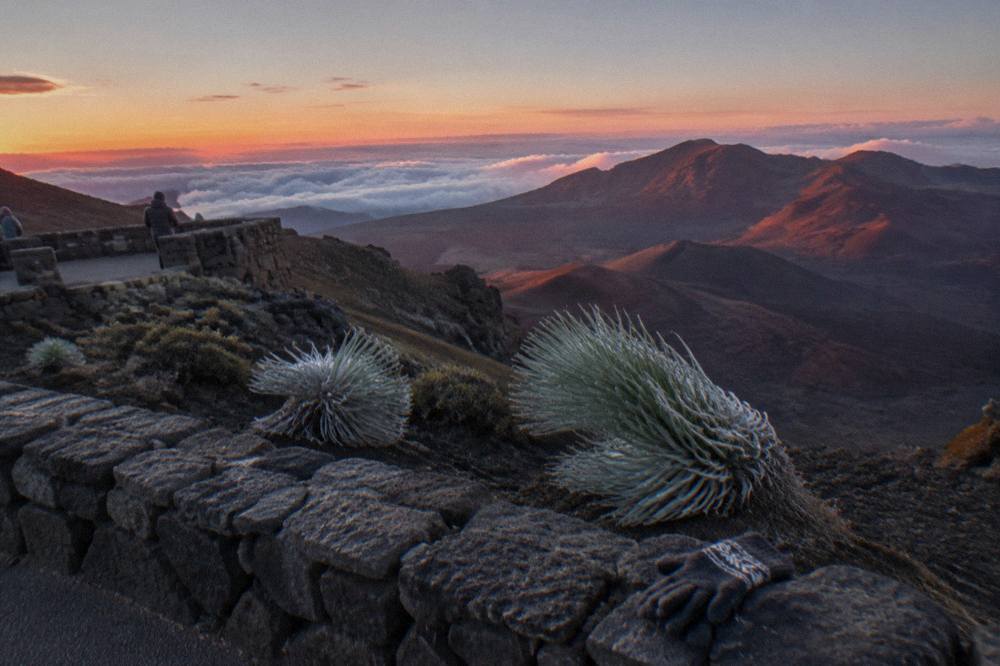
The National Park Service publishes its own sunrise guidance, including the reservation window that runs from 3:00 a.m. to 7:00 a.m. every day, on the official Haleakala sunrise page. That window matters here: a 5:44 a.m. June sunrise means the entire drive up happens inside the reservation window, while a January visit at 7:04 a.m. sits right on its edge.
How Early Should You Leave For Haleakala Sunrise?
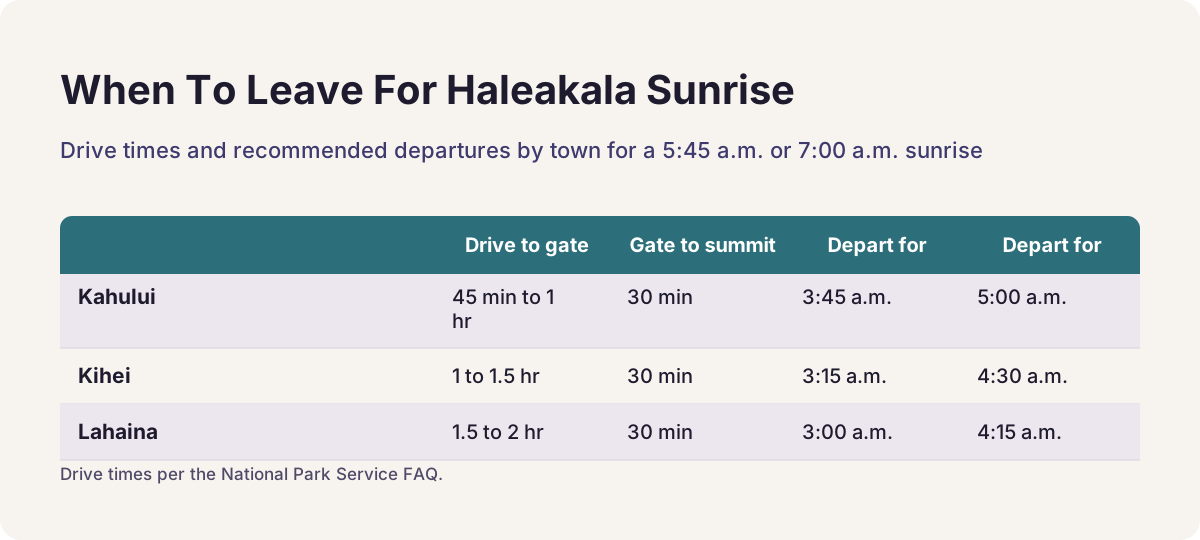
Leave Lahaina 1.5 to 2 hours before the times below, Kihei 1 to 1.5 hours, and Kahului 45 minutes to 1 hour, then add the 30-minute drive from the entrance gate to the summit lots. In practice that means a 3:00 a.m. departure from Lahaina for a June sunrise, and closer to 4:30 a.m. from Kihei in January. Aim to arrive 30 to 45 minutes before the listed sunrise time.
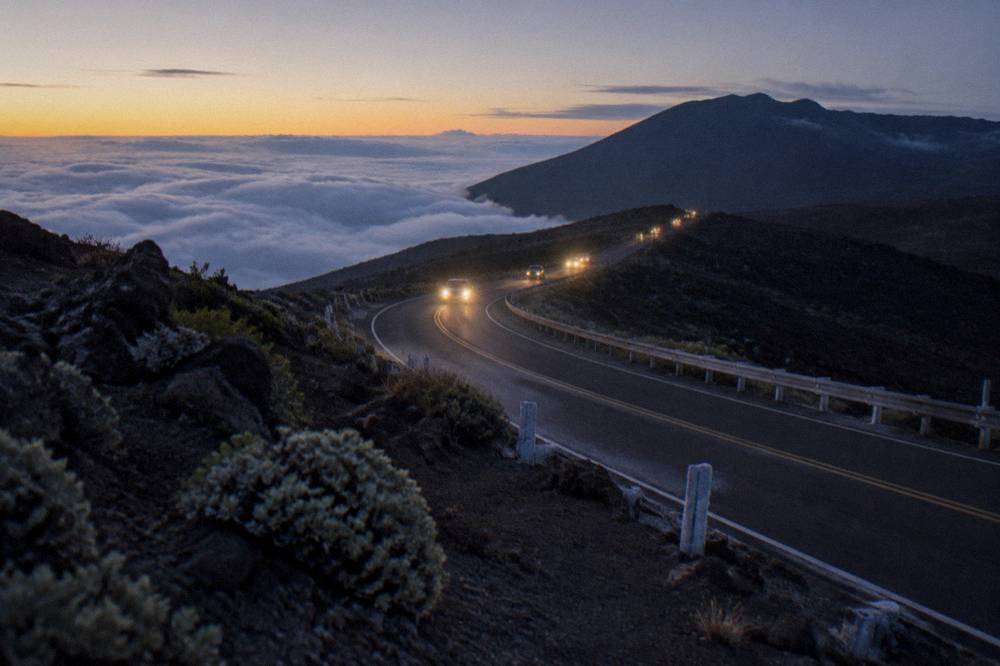
The park's own FAQ gives the drive times, and they are worth taking seriously rather than trimming: Kahului to the Summit District is 45 minutes to 1 hour, Kihei 1 to 1.5 hours, Lahaina 1.5 to 2 hours, and the paved climb from the entrance gate to the summit is another 30 minutes covering 11 miles. The road has no streetlights and no guard rails in places, and the park notes that parking lots close when they fill. The 150-vehicle capacity means the buffer is not optional.
| Departure town | Drive to Summit District entrance | Gate to summit | Recommended departure for a 5:45 a.m. sunrise | Recommended departure for a 7:00 a.m. sunrise |
|---|---|---|---|---|
| Kahului | 45 min to 1 hr | 30 min | 3:45 a.m. | 5:00 a.m. |
| Kihei | 1 to 1.5 hr | 30 min | 3:15 a.m. | 4:30 a.m. |
| Lahaina | 1.5 to 2 hr | 30 min | 3:00 a.m. | 4:15 a.m. |
Those departure times assume a 30 to 45 minute margin for parking and walking to a viewpoint, and they still feel aggressive to many visitors, which is a fair reaction. The alternative is letting someone else do the arithmetic. This is exactly what a sunrise tour sells: the nine-hour coach sunrise with breakfast from Skyline Hawaii picks up at hotels and condos island-wide and times the summit arrival internally, and the same logic runs the Sunrise Coach with Local Breakfast from Polynesian Adventure Tours, from $254 per person, rated 4.7 from 2,471 reviews. The drivers do this drive in the dark every morning; the guests sleep until the switchbacks. More on the tour-vs-drive tradeoff in a moment.
The reservation piece deserves its own mention because it changes the departure math. Every non-commercial vehicle entering the Summit District between 3:00 a.m. and 7:00 a.m. needs a $1.00 sunrise reservation from recreation.gov, on top of the entrance fee, and inventory often sells out within fifteen minutes of release. The full system is covered in the Haleakala sunrise reservations guide, including the 60-day and 2-day release windows. What matters for timing is that a missed reservation means no entry before 7:00 a.m., which in June turns a 5:44 a.m. sunrise into a sunrise watched from the outside of the gate.
How Cold Is It At The Summit Before Dawn?
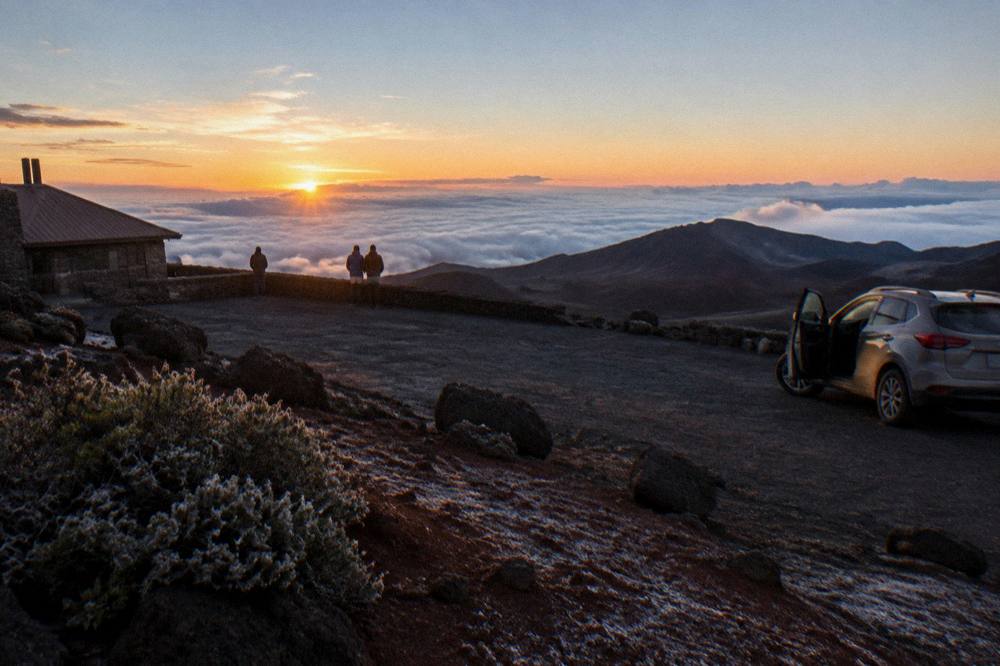
The summit runs about 30 F cooler than the coast, with mornings commonly at or below 32 F before dawn and wind chill pushing it colder. Summer summit readings still start near freezing at the 5:44 a.m. sunrise hour. Winter mornings can sit well below freezing, and the park states plainly that temperatures range from below freezing to highs of 50 to 65 F across the year.
The physics is simple: temperature drops about 3 F per 1,000 ft of elevation, and the summit stands 10,023 ft above beaches that sit at sea level. A pleasant 72 F Kihei evening translates to roughly the low 40s at Pu'u 'Ula'ula before the sun comes up, before wind and damp are added. The park's weather guidance, published on the NPS weather page, also notes that the rainy season runs November through March, so winter visitors get cold and possibly wet.
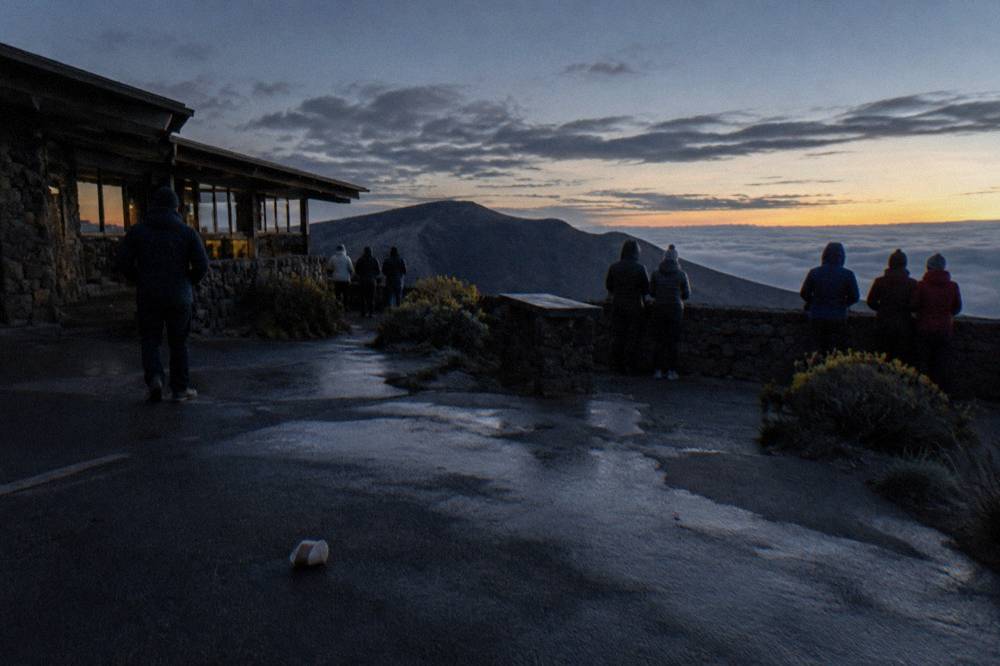
This is where tour logistics quietly earn their keep. One guest review of the small-coach Majestic Haleakala Sunrise Tour, rated 4.8 from 705 reviews, put it plainly: "Dress warmer than you think. It's freezing on top of the mountain!" The tour itself, from $264 per person with Valley Isle Excursions, carries up to 22 travellers in a small coach with breakfast included. A packing list with the full layering breakdown is in how to dress for the Haleakala sunrise; the short version is that the difference between a good morning and a miserable one at 5:30 a.m. is usually a real winter layer, not a beach hoodie.
The cold also interacts with altitude. The park warns that summit-area exertion is strenuous because of lower oxygen, that altitude sickness symptoms include nausea, headache, dizziness and shortness of breath, and that pregnant visitors and people with heart or respiratory conditions should consult a doctor first. Standing still at a viewpoint is mild effort, but the short walk from the Leleiwi Overlook lot, or the stairs at the summit, can surprise visitors whose only exercise that morning was climbing out of a van. Emergency help, the park notes, is at least an hour away, and there is no gas or food sold inside the park.
Which Sunrise Viewpoint Should You Arrive At First?
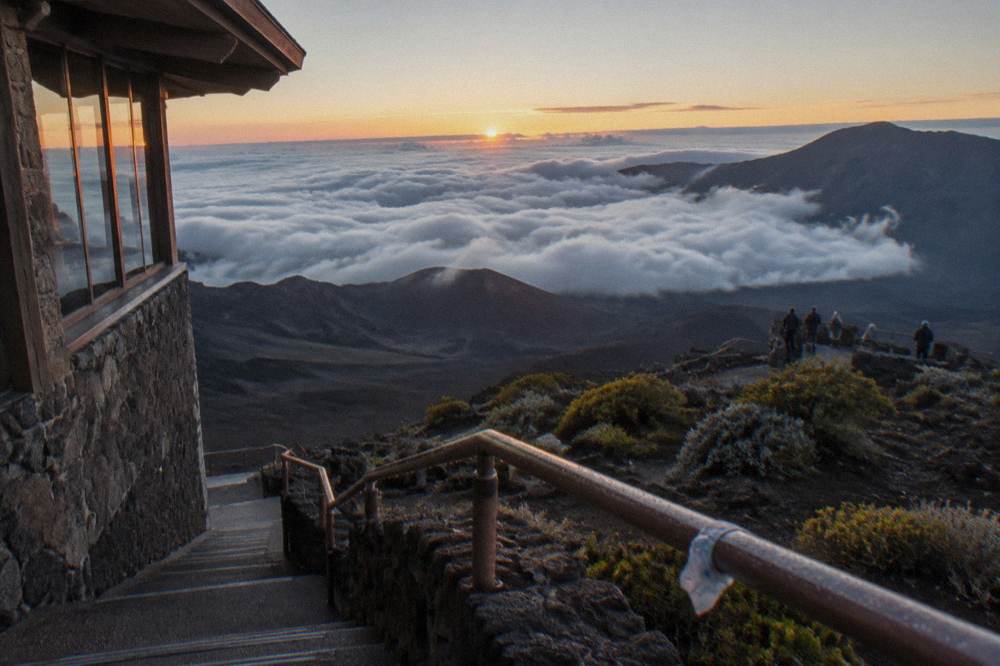
Pu'u 'Ula'ula (Red Hill) at 10,023 ft is the highest of the four sunrise viewing areas, followed by Haleakala Visitor Center at 9,740 ft, Kalahaku Overlook at 9,324 ft and Leleiwi Overlook at 8,840 ft. About 150 vehicles can access the four lots combined, and the highest lots fill first, so arrival time and lot choice are really one decision.
The four areas are officially listed by the park, and Leleiwi comes with a 10-minute hike from its lot, which thins the crowd a little. Kalahaku faces west into the crater, which changes what the first light does to the cinder cones. The summit building lot is the one most visitors picture, the classic silhouette shot with the crater dropping away to the east, and it fills accordingly.
Tours solve the lot problem the same way every morning: they arrive early, hold a fixed plan, and their commercial authorization covers the vehicle side of the entry. A traveler weighing both paths should read the Haleakala sunrise vs sunset comparison before committing to a pre-dawn start at all, because sunset needs no reservation, no 3 a.m. alarm, and runs roughly 30 F warmer at the same overlooks.
How Does Sunrise Time Set The Tour Pickup Clock?
Every commercial sunrise tour back-calculates its pickup schedule from the sunrise time, so June pickups start near 2:00 a.m. and January pickups start closer to 3:30 to 4:00 a.m., depending on the town and the tour length. The nine-hour Skyline Hawaii sunrise tour, the 10-hour Sunrise Coach and the 8-hour small-coach option all absorb the same drive times the self-driver faces; the difference is who is awake for them.
The roster of live listings shows how differently operators spend the same pre-dawn hours. The Sunrise Spectacular with Local Breakfast from Polynesian Adventure Tours runs 10 hours and carries up to 72 travellers, from $254 per person, rated 4.7 from 2,471 reviews, with a full breakfast and a Maui Tropical Plantation stop after the summit. The Skyline Hawaii nine-hour option, from $236 per person, rated 4.7 from 678 reviews, keeps the pickup net wide, hotel or condo pickup and drop-off island-wide. The Classic Vehicle Sunrise Tour with Breakfast from Bike Maui and Haleakala EcoTours runs 7 hours, up to 96 travellers, from $287 per person, rated 4.6 from 175 reviews, and meets at the Kahului Park & Ride rather than picking up at hotels.
| Tour (decision name) | Duration | Price from | Rating and reviews | Pickup |
|---|---|---|---|---|
| Sunrise Coach, Local Breakfast | 10 hours | $254 per person | 4.7 from 2,471 reviews | Select Maui hotels |
| 9-Hour Sunrise with Breakfast | 9 hours | $236 per person | 4.7 from 678 reviews | Hotel or condo, Maui |
| Small-Coach Sunrise Breakfast | 8 hours | $264 per person | 4.8 from 705 reviews | South and West Side hotels |
| Classic Vehicle Sunrise, No Pickup | 7 hours | $287 per person | 4.6 from 175 reviews | Meet at Kahului Park & Ride |
The nine-hour tour deserves a specific word because it is this site's featured pick for the planning reader: the Haleakala National Park Sunrise Tour from Skyline Hawaii includes breakfast, lists hotel or condo pickup and drop-off, and states free cancellation on the listing, with the cutoff on the booking page. One guest on the small-coach Valley Isle Excursions tour, Jason_S, described the discipline that a sunrise-driven schedule demands: "Everything was super tight. From the pickup time. To the timing of breakfast and the drop off." That tightness is the product. Sunrise time is fixed; everything else is scheduling around it.
Bike tours run on the same clock with one wrinkle. The guided sunrise bike option carries guests by van to the summit for sunrise, then a guided bike ride down the slopes with the ride starting below the summit and park boundary, while the self-guided version, from $273 per person and rated 4.7 from 777 reviews, follows the same van-to-summit pattern with riders descending from about 6,500 ft at the park boundary on their own. The guided option, from $318 per person with up to 24 travellers, is the one in the selection band above. One rider, Kurt_B, called the guided ride "the highlight of our trip" and noted "there were only a few places where I even had to pedal." The bike category overall is covered in depth in the Haleakala bike tours guide.
Does A Tour Or Self-Driving Get You There Earlier?
Authorized commercial sunrise tours operate under their own park authorization, so a self-driver needs the $1.00 recreation.gov reservation and a tour passenger does not book one personally. Neither path gets anyone a better sunrise: the sun comes up on the same schedule for both, and the summit lots hold the same roughly 150 vehicles. The real difference is who absorbs the 3 a.m. math, the dark drive, and the parking risk.
The National Park Service lists four authorized road-based tour companies on its concessions page: Haleakala Ecotours, Valley Isle Excursions, Skyline Eco-Adventures and Polynesian Adventure Tours. That is the park's own list, and it maps closely onto the coach tours on this site's roster. A self-driver books the reservation at the recreation.gov sunrise facility page, where releases go live at 7:00 a.m. HST up to 60 days ahead, with a portion held back until 2 days out.
Cost comparison is honest math rather than marketing. A couple driving themselves from Kihei pays $30 for the vehicle entrance fee, valid 3 days and covering both districts, plus the $1.00 reservation: $31 total, and the fee stays valid for a return sunset or crater visit. A couple on the nine-hour Skyline tour pays from $236 per person each, so the tour price multiplies by two, and receives breakfast, the drive, the guiding and the admission the listing states is included. The middle case is a family: the coach price multiplies by headcount while the car price does not, which is why families with children often land on the coach and solo travelers often land on the rental car. The entrance fee details, including the $55 annual pass and pass options, are laid out in the entrance fee and passes guide.
What If You Miss The Sunrise Window Entirely?
If you arrive after the lots fill, or after 7:00 a.m. without a reservation, the visit does not fail, it changes shape: mid-morning summit light, the crater hikes, and the drive back down are all still there, and sunset needs no reservation at all. The park is open 24 hours, so the day is recoverable, just oriented differently.
The most common miss is not oversleeping but underestimating the buffer. The second most common is a full summit lot, which sends late arrivals down to Kalahaku or Leleiwi, still legitimate viewpoints, just a few hundred feet lower. Visitors who land mid-morning can walk the Hosmer Grove loop, 0.54 miles, or the first overlook of Sliding Sands, a half mile round trip from the visitor center lot, both detailed in the Sliding Sands trail guide.
The other recovery is the one a growing number of visitors choose on purpose. One guest on the Twilight Sunset Tour with Dinner, Stefanie_R, wrote: "Sunset is 1000xs better than sunrise, too!" That is one opinion, but it is an informed one, and the sunset and stargazing tours hub lays out the evening alternatives, several of which include dinner or astronomy guiding. Visitors can also weigh the question directly in is sunset on Haleakala worth it.
| Plan B after a missed sunrise | Reservation needed | Best time | What it delivers |
|---|---|---|---|
| Mid-morning summit visit | No, entrance fee only | 8 to 10 a.m. | Crater views, short hikes, thinning crowds |
| Hosmer Grove loop walk | No, entrance fee only | Any daylight | 0.54 mile nature loop |
| Sunset from the summit | No | 30 to 60 min before listed sunset | Same overlooks, warmer, no alarm |
| Guided sunset tour with dinner | No | Tour-dependent | Transport, meal, dark-drive handled |
Haleakala Sunrise Time By Month: Quick Reference
The short version: June sunrise is 5:44 a.m., January sunrise is 7:04 a.m., and the departure clock follows the table, roughly 3:00 a.m. from Lahaina in June and 4:15 a.m. from Lahaina in January. Arrive 30 to 45 minutes early, hold a reservation if driving, and treat anything under that buffer as a plan to watch the sun rise from the road.
Visitors who want the full decision framework in one place, including the reservation mechanics, the tour roster and the bike and hike options, can start with the things to do at Haleakala guide or the Haleakala sunrise tours hub. This site, Haleakala National Park Tours, tour prices and times can change, so confirm current details on the live booking page before you book, so the numbers above are the numbers to plan from.
For travelers who have done the arithmetic and decided the arithmetic is the problem, the three listings below are the ones this site compares most often for the pre-dawn run: the nine-hour coach sunrise with breakfast, the small-coach alternative, and the guided sunrise bike tour that turns the descent into the second half of the morning.
Common Questions About Haleakala Sunrise Times
What time is sunrise at Haleakala in June?
Sunrise at the summit is about 5:44 a.m. in mid-June, the earliest of the year. Plan to be at your viewpoint by about 5:10 a.m., which means leaving Lahaina around 3:00 a.m. or Kihei around 3:15 a.m.
What time is sunrise at Haleakala in January?
About 7:04 a.m. in mid-January, the latest of the year. That pushes departures to roughly 4:15 a.m. from Lahaina or 4:30 a.m. from Kihei, and it is also the coldest month, with summit mornings commonly at or below freezing.
How long before sunrise should I arrive at the summit?
Arrive 30 to 45 minutes before the listed sunrise time. The four viewing lots hold about 150 vehicles combined and close when full, and the walk from some lots, such as Leleiwi Overlook, adds another 10 minutes.
Do sunrise tours leave earlier in summer than winter?
Yes. Every tour back-calculates its pickup from the sunrise time, so June pickups can start near 2:00 a.m. while January pickups start closer to 3:30 to 4:00 a.m., depending on your town and the tour's duration.
Does sunrise time affect the $1.00 reservation window?
The reservation window is fixed at 3:00 a.m. to 7:00 a.m. every day regardless of season. In June the whole drive happens inside that window; in January a 7:04 a.m. sunrise sits just past its edge, but you still need the reservation to enter before 7:00 a.m.
Is Haleakala sunrise the same time as sunrise on the beach?
Nearly, but not exactly. The summit table is computed for the 10,023 ft horizon; sea-level Maui sunrise differs by a few minutes. For planning the drive, use the summit times and the park's stated drive times from your town.