How Long Does It Take To Hike Haleakala Crater?
Trail by trail timing for hiking Haleakala Crater, from the half-mile Sliding Sands overlook to the full 11-mile crossing, plus what a guided crater hike adds.
How Long Does It Take To Hike Haleakala Crater?
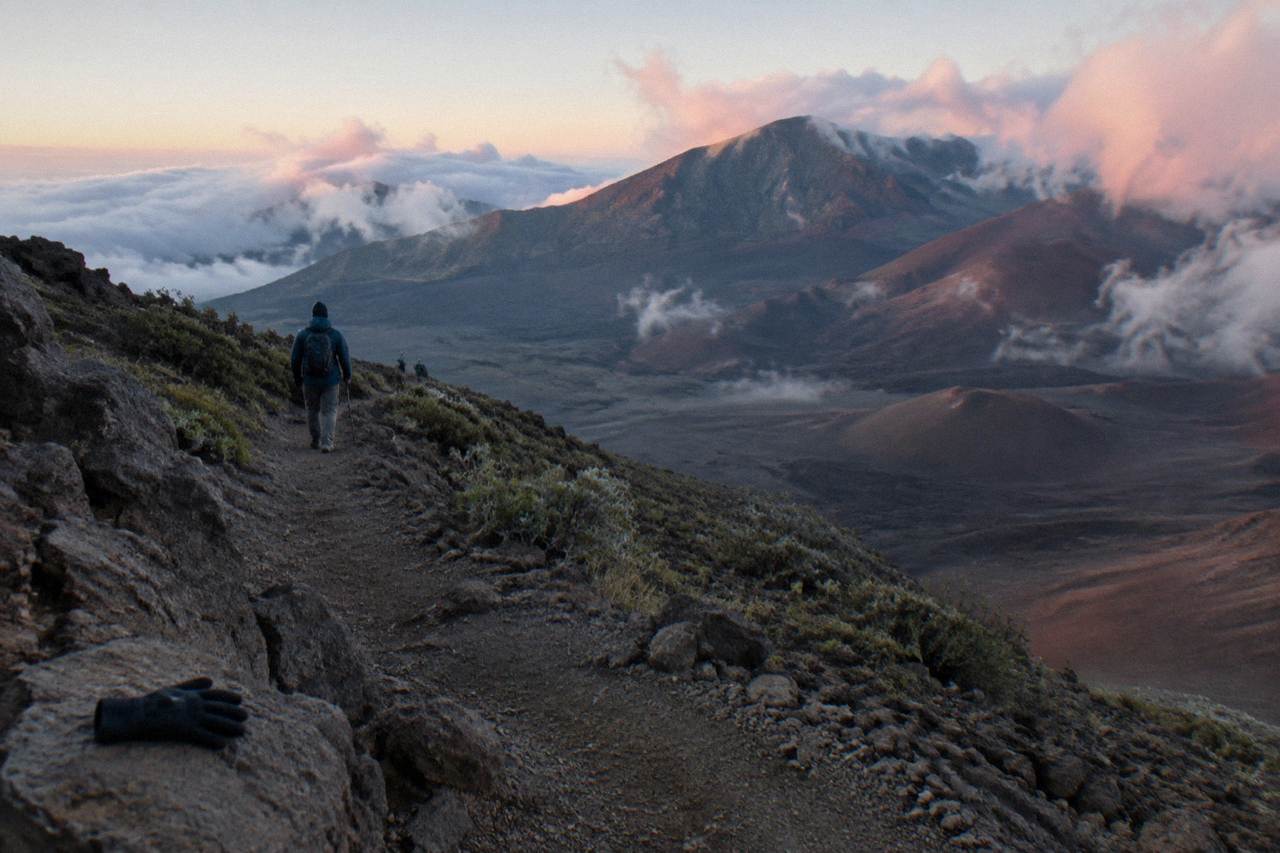
Most hikers should plan on 30 minutes for the first Sliding Sands overlook, 3 to 5 hours for the round trip to the crater floor, and 6 to 8 hours for the full 11-mile crossing ending at the Halemau'u trailhead. Those totals include rests, because the National Park Service warns that hiking out takes about twice as long as hiking in, and the cinder surface and high elevation slow everyone down. If those hiking times sound like more commitment than you want, many visitors trade boots for brakes and simply check how long the bike ride down the mountain takes instead.
That "twice as long coming out" rule is the single most important timing fact on this mountain, and it comes straight from the park's own safety guidance. Hikers who budget only for the downhill half routinely misjudge the day. Sand and cinders slide underfoot on the way in, which feels fast, and then the same surface steals a step back on every stride on the way out, at altitude, in whatever weather the crater has decided to produce by afternoon.
There is a second timing trap that has nothing to do with your legs: the park offers no hiker shuttle. If you cross the crater from Keonehe'ehe'e (Sliding Sands) to Halemau'u, you finish on the opposite side of the wilderness from where you parked. Parties solve this with two cars, a very early shuffle, or by turning it into an overnight with a wilderness permit. A listing or a guide changes that arithmetic completely, which is why the guided crater hike we cover further down is worth sizing early.
If you are still choosing how to spend the day, these three guided options bracket the range from a full crater hike to private summit experiences:
What Sets Your Hiking Time On Haleakala?
Three variables dominate the clock: distance and elevation change, the cinder surface itself, and how your body handles elevations between 6,380 and 9,780 ft, the range the park gives for its summit-area trails. Fitness matters less than pacing and hydration here. The park lists altitude sickness symptoms as nausea, headache, dizziness and shortness of breath, and advises anyone who is pregnant or has heart or respiratory conditions to consult a doctor first.
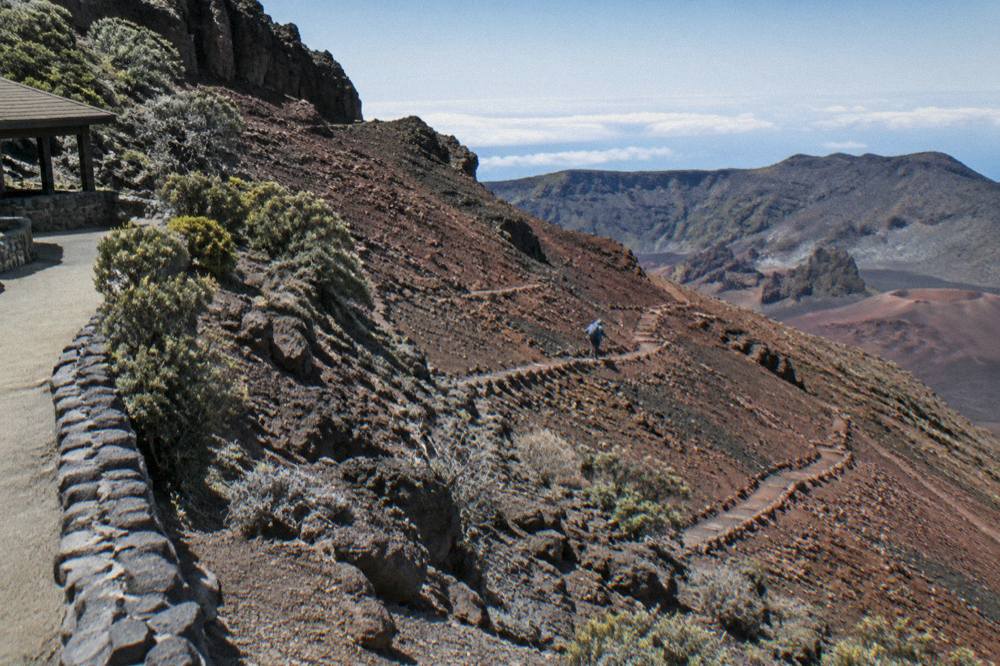
The surface deserves its own sentence. Sliding Sands is named honestly: the descent is soft underfoot, and the park's hiking page notes that trails here are strenuous largely because of lower oxygen. A pace you would hold on a mainland trail at sea level simply does not transfer. Most experienced hikers report their crater pace at something like two-thirds of their normal trail pace, and their climbing pace slower still.
Weather can also compress or extend the day. The summit runs about 30 F cooler than the coast, mornings are commonly at or below freezing, and the rainy season from November through March can put cloud and wind into the crater by late morning. Early starts are not just for sunrise photographs; they are how you buy calm air and clear light for the descent view. Conditions change quickly, and the park's own current conditions page is the place to check the morning of your hike.
Because the guided option removes nearly all of the timing guesswork, it is worth asking whether it fits your plans before you commit to a self-guided day.
How Long Is The Sliding Sands Trail To The Crater Floor?
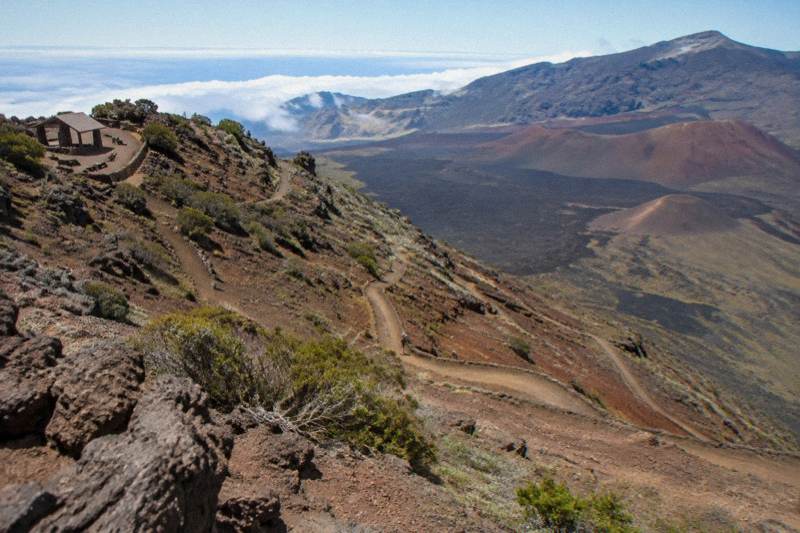
The Keonehe'ehe'e, or Sliding Sands, trailhead sits in the Haleakala Visitor Center parking lot at 9,740 ft. The first overlook is a 0.5 mile round trip with about 50 ft of elevation change, which takes most visitors 20 to 30 minutes at a casual pace. Reaching the crater floor is roughly 3.9 miles one way with about 2,500 ft of descent, and the park grades it as a strenuous half-day outing.
That first half mile is the great equalizer. It is the walk most summit visitors can do in whatever shoes they arrived in, and it delivers a genuine over-the-rim view of the crater without committing you to the climb back out. Treat it as a scouting trip: if the cinders feel sketchy going down that far, you have learned something cheap about the full trail.
Going on to the floor changes the commitment scale entirely. Count on 2 to 2.5 hours down and, honoring the twice-as-long-out rule, 4 or more hours back up to the rim, so 6 hours is a realistic round-trip budget with breaks. Start by 8 a.m. and you are off the trail with daylight to spare; start at noon and you are climbing out in the afternoon wind, when the crater is at its least forgiving. Our trail guide to Sliding Sands and the crater rim breaks the route down stop by stop if you want the full picture.
How Long Is The Full Crater Crossing To Halemau'u?
The popular full crossing runs about 11 miles, roughly 17.8 km, one way from the Sliding Sands trailhead to the Halemau'u trailhead, which sits at 7,990 ft. With the no-shuttle logistics, most parties treat it as a 6 to 8 hour hiking day plus a car shuffle, or as an overnight with a wilderness permit and one of the historic cabins. Either way, it is the biggest walking commitment inside the park.
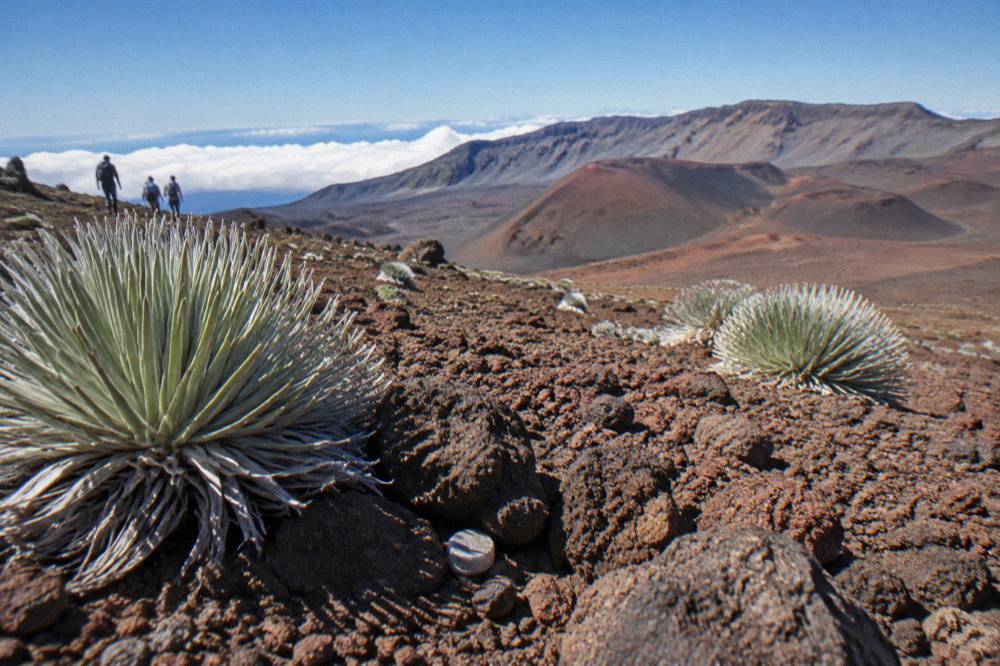
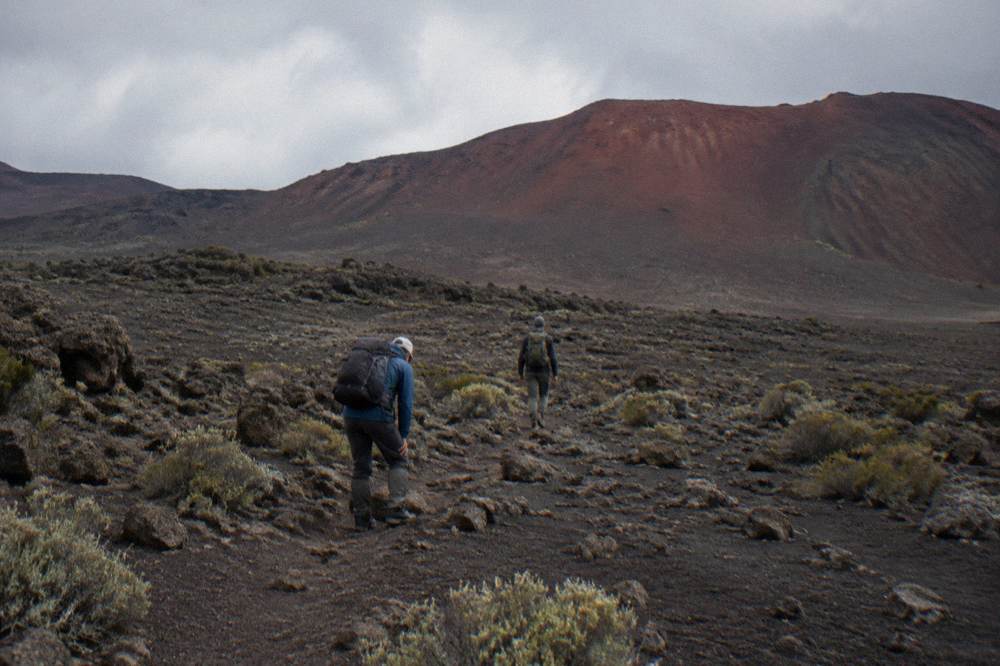
The crossing is quiet in a way the sunrise crowd never sees. Once you drop off the rim, the day belongs to silversword country, cinder cones and the strange stillness of a floor that sits below the reach of most visitors. The trade-off is planning: water is not available on the trail, there is no cell service in the crater, and the park states that emergency help is at least an hour away. This is a hike you brief for, not one you improvise.
Timing-wise, 6 hours is a fast party on a good day; 8 is realistic with photo stops and a real lunch. The uphill final stretch to the Halemau'u trailhead is shorter and gentler than the Sliding Sands wall would have been, which is exactly why the crossing is usually walked in this direction. For anyone sizing guided hiking options across the park, the guided Haleakala hiking guide compares what operators actually deliver.
| Route | Distance | Elevation change | Realistic time | Grade |
|---|---|---|---|---|
| Sliding Sands first overlook | 0.5 mi round trip | 50 ft | 20 to 30 minutes | Easy |
| Sliding Sands to crater floor and back | About 3.9 miles each way | About 2,500 ft down and up | 5 to 6 hours | Strenuous |
| Full crossing, Sliding Sands to Halemau'u | About 11 mi one way | Net descent, then climb to 7,990 ft | 6 to 8 hours plus car shuttle | Strenuous |
| Halemau'u to crater viewpoint | 2.2 mi round trip | 400 ft | About 1 to 1.5 hours | Moderate |
| Hosmer Grove loop | 0.54 mi loop | 50 ft | 20 to 30 minutes | Easy |
Distances and elevations above are the park's own figures from its hiking page; times are planning ranges built on the park's twice-as-long-out guidance, not promises.
Can You Hike Haleakala Crater In One Day?
Yes, and most people do. The half-mile overlook, the Halemau'u viewpoint and a guided crater hike all fit inside a single day, and even the full crossing is done as a day hike by fit parties willing to manage two cars. What does not fit in one day is cramming the crater together with a long second activity; the drive alone from Kahului runs 45 minutes to an hour each way, longer from Kihei or Lahaina.
The realistic day looks like this: leave your base in the dark or at dawn, reach the Summit District entrance, drive the roughly 30 minutes and 11 miles of paved road from the entrance gate to the top, hike through the middle of the day, and descend the mountain before the late-afternoon clouds stack up. That is a full day for one district. Trying to bolt on the Road to Hana afterward does not work; Kipahulu, the coastal district, is a 2.5 to 3 hour drive from Kahului on its own.
For travelers who want both sides of the park without the windshield time multiplying, there is a category of tour that pairs them. The Road to Hana Halfway and Haleakala National Park combo by Aloha Eco Adventures covers the halfway section of the Hana Highway plus about 2 hours in the national park in a 10-hour small-group day, rated 4.8 from 41 reviews, from $259 per person with hotel pickup offered from Central, South and West Side hotels. It trades hiking depth for coverage, which is a fair swap if this is your one big Maui day.
How Long Does A Guided Crater Hike Take?
The Haleakala Crater Hiking Experience by Hike Maui runs about 7 hours door to trail and back, from $208 per person, in a small group with a meal included and a minimum of 4 travellers to run. Its listing covers a Haleakala Crater hike in the Sliding Sands area, and it is rated 4.8 from 74 reviews. Those hours include transport logistics and interpretation, not just walking time. If a fixed small-group schedule feels restrictive, our guide to private Haleakala tours with flexible timing shows how going private lets you shape the day around your own pace.
A guided day buys three things a timing guide cannot. First, someone else solves the trailhead and the driving in the dark. Second, a guide sets the pace to the group and the altitude rather than to a clock, which is the difference between finishing strong and dragging up the last switchbacks. Third, the operator handles the details the park makes you handle yourself otherwise, from water planning to reading the morning weather. This site, Haleakala National Park Tours, compares the guided options side by side, and the crater hiking experience is the one built exactly around this question.
If seven hours of hiking-shaped day sounds like too much, the private alternatives shorten the commitment. The Private Haleakala Summit & Stroll from Kahului by Holo Holo Maui Tours runs about 5 hours, from $359 per group, rated 5 from 69 reviews, with crater admission included. Haleakala Private Sunset Tours by Aloha Wild Tours runs about 5 hours from $555 per group with a crater stop and admission included; it carries only 7 reviews, too few for a star claim, so judge it on its itinerary rather than its rating.
| Guided option | Duration | Price from | Rating and reviews | Group |
|---|---|---|---|---|
| Haleakala Crater Hiking Experience (Hike Maui) | 7 hours | $208 per person | 4.8 from 74 reviews | Small group, 4 traveller minimum |
| Private Haleakala Summit & Stroll (Holo Holo Maui Tours) | 5 hours | $359 per group | 5 from 69 reviews | Private |
| Haleakala Private Sunset Tours (Aloha Wild Tours) | 5 hours | $555 per group | 7 reviews, too few for a star claim | Private |
All three run under operators with their own park authorization for road-based touring; the listing for the crater hike states Sliding Sands area access, and each row above reflects what its own listing prints.
How Long Do The Shorter Summit Walks Take?
The Halemau'u Trail to its crater viewpoint is 2.2 miles round trip with 400 ft of elevation change, a 1 to 1.5 hour outing. The Hosmer Grove loop is a 0.54 mile nature trail that takes 20 to 30 minutes. In the Kipahulu District, the Pipiwai Trail to the Waimoku Falls viewing area is 4 miles round trip with 800 ft of gain, a solid half-day walk through bamboo to a 400-foot falls.
Halemau'u deserves more attention than it gets from timing-minded visitors. Its viewpoint walk delivers a crater panorama for a fraction of the Sliding Sands effort, and because the trail starts low at 7,990 ft, it is kinder to anyone feeling the altitude. The park notes a viewpoint formation nicknamed the Rainbow Bridge area lies at the turnaround. As a half-day plan, Halemau'u in the morning pairs naturally with the Hosmer Grove loop, which sits just off Crater Road and doubles as a warm-up walk at any point of the day.
Kipahulu is a different question entirely, because getting there costs more time than the hike. The district entrance lies 12 miles past Hana, and driving from Kahului runs 2.5 to 3 hours each way. The Pipiwai Trail itself is one of the best walks in the Hawaiian islands, but budget the whole day for it. While you are there, note the standing closure: the Pools of 'Ohe'o are closed to entry and swimming, and are viewed instead from the Kuloa Point Trail. Our deeper write-up of Pipiwai and the Kipahulu District covers that plan.
How Should You Budget Time For Weather And Altitude?
Pad every self-guided estimate by at least an hour, start as early as logistics allow, and treat 32 F before dawn as normal rather than exceptional. The park states the summit runs about 30 F cooler than the coast, that before-dawn conditions are regularly wet, windy and below freezing, and that there is no gas, food or cell service in the crater. Emergency help is at least an hour away.
The practical checklist is short. Carry more water than feels reasonable, eat before you are hungry, and turn around at a fixed time rather than a fixed point: whatever the clock says at your chosen turnaround, the way out will take about twice what the way in took. Sun protection matters as much as warmth; the UV on the upper mountain is fierce even when the air is cold, and the crater offers no shade of any kind.
Altitude deserves respect, not fear. Symptoms of nausea, headache, dizziness or shortness of breath are the park's stated warning signs, and its advice is to descend if they worsen. Visitors who are pregnant or who have heart or respiratory conditions should talk to a doctor before committing to a crater hike. Slower hikers should pick the Halemau'u viewpoint or the first Sliding Sands overlook, both of which deliver real crater views on modest clocks, a point we also make in our piece on whether Haleakala is a difficult hike. If you're still weighing whether your legs and lungs are up for it, our honest trail-by-trail breakdown of Haleakala's difficulty covers everything from short overlook walks to the full crater crossing.
What If You Want The Crater Without The Hours?
Not every visitor wants a 6-hour walking day, and the crater can be seen from a vehicle, a viewpoint or the air instead. The classic vehicle sunrise tours spend their hours on transport and the rim rather than on the trail, and a helicopter flight over the crater compresses the experience into 45 minutes. Neither is a hike, and both deliver the scale of the place.
The Hana Rainforest and Haleakala Crater Helicopter Tour by Air Maui Helicopter Tours flies over the Hana rainforest and the crater, a flyover rather than a landing, in 45 minutes from $368 per person, rated 4.7 from 155 reviews. One guest review on the listing sums up the trade: "The ride was short (45 min) but didn't really feel that way - we saw a lot! Loved this perspective of the island - it's much bigger than we thought." For anyone whose knees have opinions about cinder descents, that perspective is a legitimate alternative.
On the ground, the rim itself is the shortcut. The park lists four sunrise viewing areas between 10,023 and 8,840 ft, reachable by car, and the Leleiwi Overlook requires only a 10-minute hike from its lot. Visitors who want the early-mountain experience without the hike often choose a vehicle sunrise tour such as the Classic Vehicle Sunrise Tour with Breakfast by Bike Maui and Haleakala EcoTours, a no-biking, 7-hour vehicle tour from $287 per person, rated 4.6 from 175 reviews, with crater admission included. One guest described stopping to take in the Milky Way on the way up and a spectacular sunrise at the top. Whether you hike the floor or watch from the rim, the crater keeps the same schedule: early, cold and unforgettable.
If a guided hike is the right shape for your day, these three options cover the range from a full crater hike to private summit and sunset outings:
Common Questions About Hiking Haleakala Crater
How Long Does It Take To Hike Haleakala Crater?
Plan on 20 to 30 minutes for the first Sliding Sands overlook, 5 to 6 hours for the round trip to the crater floor, and 6 to 8 hours plus a car shuttle for the full 11-mile crossing to Halemau'u. The park's guidance that hiking out takes about twice as long as hiking in should shape every estimate.
Can You Hike Haleakala Crater In One Day?
Yes. The overlook walks, the Halemau'u viewpoint, the crater floor round trip and even the full crossing are all done as day hikes, though the crossing needs two cars because there is no hiker shuttle. Fit parties should still start early to finish before afternoon wind and cloud build.
How Hard Is The Sliding Sands Trail?
The first overlook is an easy 0.5 mile round trip. Beyond that the park grades the trail strenuous: about 2,500 ft of loose cinder descent to the floor, then the same climb back out at altitude. Soft footing and thin air, not steepness, are what make it hard.
Do You Need A Permit To Hike In The Crater?
Day hiking needs no permit, just the park entrance fee, which is $30 per private vehicle for 3 days covering both districts. Overnight camping in the wilderness or the historic cabins does require a permit and reservations, with a maximum of 3 overnight stays in any 30 days across the park.
Is A Guided Crater Hike Worth The Time?
A guided hike such as the Haleakala Crater Hiking Experience by Hike Maui runs about 7 hours, from $208 per person, with a meal and Sliding Sands area hiking included, rated 4.8 from 74 reviews. It costs no more calendar time than a self-guided floor hike and removes the driving, pacing and water-planning decisions.
What Is The Shortest Real Crater Hike?
The Halemau'u Trail to its crater viewpoint is the best short option: 2.2 miles round trip with 400 ft of elevation change, about 1 to 1.5 hours. The first Sliding Sands overlook at 0.5 mile round trip is shorter still and starts right at the Haleakala Visitor Center lot.